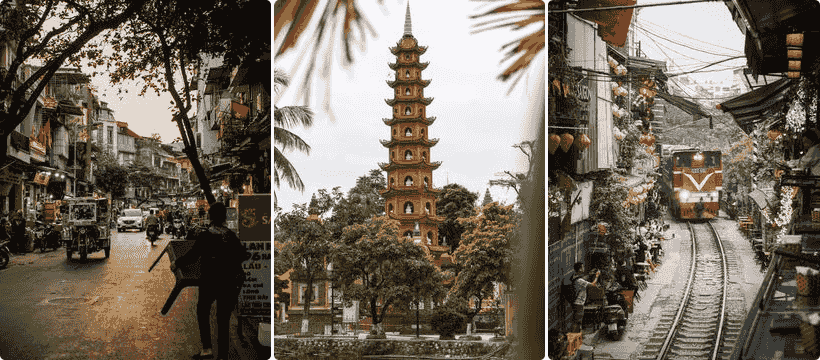
3. Getting Around Hanoi
Hanoi has no tourist-accessible metro covering the key sightseeing areas (the new Metro Line 3 extension opened in 2024 but serves mainly suburban commuters). Getting around the city means choosing between Grab, xe om (motorbike taxi), cyclo, city bus and taxis. For most visitors, Grab handles 90% of transport needs.
Grab (Ride-Hailing)
✅
Grab Car: Fixed price, air-conditioned, reliable. Most journeys within the Old Quarter and central Hanoi: ₫30,000–80,000. Airport (Noi Bai) to Old Quarter: ₫200,000–280,000 (45–60 min depending on traffic). Surge pricing applies during peak hours.
✅
Grab Bike: Fastest option for short trips within the Old Quarter and central areas. ₫15,000–40,000 for most local journeys. Significantly faster than cars through Old Quarter traffic. Helmets provided — use them.
✅
Cyclo (xích lô): Three-wheeled bicycle rickshaw — primarily a tourist experience rather than practical transport. Negotiate price before boarding (₫100,000–200,000 for a 30-min Old Quarter circuit). Offers a uniquely low perspective on the Old Quarter street life.
⚠️
Metered taxis: Mai Linh (green) and Vinasun (white) are the only recommended metered taxi companies. Starting fare: ₫12,000–15,000. Avoid unlicensed taxis and any driver who refuses to use the meter — use Grab for transparent pricing instead.
⚠️
Crossing the street: Hanoi traffic does not stop at crossings. The technique: walk slowly and steadily — motorbikes flow around you. Do not stop or run. Once you start crossing, maintain a consistent pace. This is counter-intuitive but correct.
"
Grab saved us every day in Hanoi. ₫35,000 to anywhere in the centre, fixed price, the driver comes to you. The street crossing technique takes one day to master and then it becomes completely natural. After that, Hanoi traffic stops being intimidating and starts being fascinating.
— Google Maps user T.Eriksson_Gothenburg, Hanoi transport review (verified, October 2025)
4. Practical Info: Money, SIM & Safety
Money & Payments
💵
Hanoi is predominantly cash-based. Street food, markets, temples, cyclos, xe om and smaller guesthouses all require cash. Always carry ₫200,000–500,000. Note: Vietnamese dong uses large denominations — ₫500,000 is approximately $20. Take care counting notes; the colour coding is similar between some denominations.
🏧
ATMs: Vietcombank, BIDV and Techcombank ATMs are the most reliable for international cards. Fee: ₫25,000–85,000 per withdrawal depending on bank. Maximum withdrawal per transaction: typically ₫3,000,000–5,000,000. Withdraw larger amounts less frequently to minimise fees.
💱
Currency exchange: Old Quarter gold shops (on Hang Bac Street) often offer better rates than banks or hotel desks. Rates fluctuate — compare before exchanging. US dollars are the most widely exchangeable foreign currency; major European currencies accepted at main banks.
💰
Cost reality: Hanoi is one of the world's best-value capital cities. A full pho breakfast: ₫30,000–50,000 (~$1.20–$2). A Grab across the centre: ₫30,000–50,000. A bia hoi draft beer: ₫5,000–10,000. A mid-range restaurant dinner: ₫150,000–300,000 per person. Budget ₫600,000–1,000,000/day for food, local transport and attractions.
SIM Cards
📶
Viettel or Vietnamobile tourist SIMs: Available at Noi Bai Airport arrivals hall and at every mobile phone shop in the Old Quarter. Viettel has the strongest coverage across northern Vietnam, including rural areas and mountain roads. 7-day unlimited data + 50 mins calls: ₫100,000–150,000. 30-day: ₫200,000–300,000.
📶
Registration: Vietnamese SIMs require passport. Available immediately at the airport — buy before leaving the terminal to avoid connectivity issues with Grab on arrival.
Safety
Hanoi is generally safe for tourists. The main risks are motorbike bag snatching (carry bags on the side away from the road, and keep phones in pockets on busy streets) and overcharging at non-metered transport. The Old Quarter after dark is lively rather than threatening.
🌡️
Heat: June–August temperatures reach 35–38°C with high humidity. Schedule outdoor activities before 10:00 and after 16:00. The Old Quarter has limited shade on its main streets — carry water and sun protection.
🌧️
Typhoon season: July–November brings tropical storms. Check forecasts before day trips and boat excursions. Halong Bay cruises are cancelled during severe weather warnings — reputable operators will refund or reschedule.
🏥
Medical: Hanoi French Hospital (Benh vien Viet Phap) and Vinmec International Hospital have English-speaking staff and internationally recognised standards. Travel insurance with medical evacuation cover is strongly recommended — standards vary significantly below the international hospital tier.
5. Best Time to Visit Hanoi
Hanoi has a subtropical climate with four loosely defined seasons — unusual by Southeast Asian standards. Based on Vietnam National Administration of Tourism data and seasonal review patterns:
| Season |
Months |
Weather |
Highlights |
Verdict |
| 🍂 Autumn |
Oct – Dec |
18–26°C, low humidity, clear |
Comfortable temperatures, green rice fields |
Best Overall |
| 🌸 Spring |
Mar – Apr |
17–25°C, some drizzle |
Bauhinia blossoms (Feb–Mar), Tet aftermath |
Most Pleasant |
| ❄️ Cool Season |
Dec – Feb |
10–18°C, overcast, drizzle |
Tet (Lunar New Year) — city transforms |
Good Value |
| ☀️ Hot Season |
May – Sep |
28–38°C, high humidity, storms |
Lotus season (Jun–Jul) at West Lake |
Manageable with early-morning schedule |
Tet (Lunar New Year) planning note: Tet — Vietnam's most important festival — falls in late January or February. In the week before and after Tet, Hanoi becomes either extraordinarily festive (if you time it right) or completely shut down (if you arrive during the holiday itself). Most restaurants, shops and attractions close for 3–5 days over Tet. Book accommodation months in advance and verify which sites and restaurants will be open during your specific travel dates.